50th Anniversary Video Ideas: How to Render a Lifetime Partnership with AI
Quick answer
Creating a 50th anniversary video for your parents does not require expensive software or weeks of editing.
By LifeStory AI Editorial · ·
In this guide (9 sections)
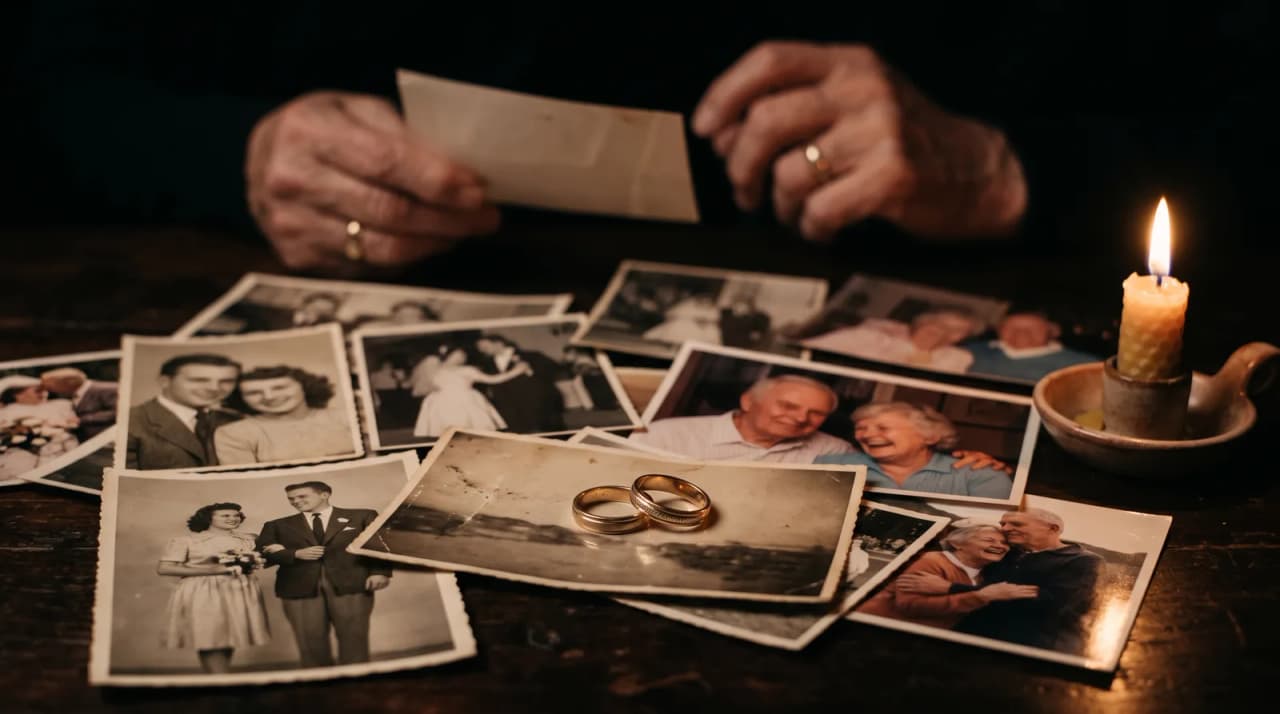
By using LifeStory AI, you can turn a handful of old photos into a cinematic, emotional evolution video that honors their fifty-year marriage (building on ideas from a 25th anniversary evolution video) in minutes.
Fifty years of marriage is not one album. It is wedding prints in a hall closet, faded Polaroids in a shoebox, and three decades of phone pictures nobody sorted. You want the golden anniversary room to feel what your parents feel when they look at those images - not to sit through a random slideshow while dessert melts.
What tends to work for a golden anniversary centerpiece?
Our recommendation: pair one physical touchpoint with one short evolution film everyone watches together. A photo board invites close-up browsing; a cinematic aging arc gives the whole room a shared emotional beat. Neither alone usually carries a fifty-year story.
Sources: Library of Congress guidance on preserving photographs (opens in new tab).
When planning a golden anniversary (or looking back at how you handled their 25th anniversary evolution tribute), the hardest part is not finding photos. It is choosing a format that honors half a century without turning into a corporate deck.
Imagine this: the toast that lands at fifty years
Imagine you are at a golden anniversary dinner. A child stands up, mentions one detail from the wedding day - a rainstorm, a wrong turn, a song on the radio - and the main screen fades from a single wedding portrait into a short evolution film. The room goes quiet. Not because anyone was told to pay attention, but because the first frame already looks like someone the guests recognize, only younger. That is the difference between a slideshow and a centerpiece.
What is the Golden Arc Method?
The Golden Arc Method is a simple way to choose and order photos for a 50-year marriage video. You need only five anchor images, one per era:
| Arc stage | Era | What to look for |
|---|---|---|
| Origin | Wedding year | Clear faces, eye contact, minimal background clutter |
| Building | Years 1-15 | Daily life, not only formal events |
| Deepening | Years 16-35 | Kids, travel, a home - proof of a shared life |
| Maturity | Years 36-49 | Grandchildren, milestones, candid present-tense joy |
| Together | Recent year | How they look now, ideally candid |
You do not need hundreds of files. Albums you scan with a phone often yield one strong anchor per decade if you hunt for expression, not perfection. Faded prints may need restoration before AI rendering so the final frame does not wash out.
Storyboard sketch: about twenty seconds, five beats
Use this storyboard when briefing whoever introduces the video:
[0:00] Wedding portrait - the opening frame, no text on screen
[0:05] Morph to early marriage - let the transition breathe
[0:10] Mid-life milestone - family or travel
[0:15] Grandchildren or later chapter - the "what they built" beat
[0:20] Recent candid - final frame, then fade to toast or applause cue
Golden Arc Method at a glance
Wedding
   ↓
Building years
   ↓
Family peak
   ↓
Empty nest
   ↓
Golden today
How does LifeStory AI fit a golden anniversary reveal?
LifeStory AI handles alignment and transitions between your anchor photos so you are not learning editing software the week of the party. Upload a small set of era-spanning images, and the platform produces a cinematic evolution sequence in minutes. Privacy matters for family archives: uploads are stored encrypted, used only to create your video, and deleted on request.
The same anchor logic works for a couples relationship timeline built from first date to wedding - start with the moment the story began, end with who they are today.
What are other creative layers for the evening?
A digital centerpiece works best when guests have something to touch before and after the screen moment:
- Recreate the first date corner: A small table echoing where they met.
- Curate a 50-year playlist: Songs from their wedding year through today.
- Design a milestone map: Pin cities they lived in or visited together.
- Record audio messages: Short voice notes from children and grandchildren.
How do you time the video reveal?
Timing is everything. You want a captive audience without killing the party's energy.
| Event stage | Action | Why it works |
|---|---|---|
| Cocktail hour | Screens off or one static wedding photo | Builds anticipation without spoiling the surprise |
| After mains cleared | Guests seated, lights slightly dimmed | Fewer distractions than during service |
| During a toast | A child or friend introduces the film | Connects the video to a real voice in the room |
| The reveal | Play the evolution video on the main screen | Delivers a fast, shared emotional peak |
The same seated-reveal timing runs through our event deployment guide — loop short during cocktails, reveal once when everyone is seated.
Cross-method note: If you built a silver party film with the Silver Arc Method, the same five-era logic scales directly into the Golden Arc Method with two new anchors, not a new archive hunt.
What have we noticed?
We've noticed golden-anniversary videos that open on a recent candid and morph backward lose the room — start on the wedding frame so every transition reads as forward time.
Our editorial take
We think most golden-anniversary videos fail because they treat fifty years like fifty similar portraits. One messy, real-life image per decade usually outperforms formal-only boards.
A surprisingly specific detail
Ask whoever gives the toast to name one small detail from the wedding day before the first morph — that single sentence primes the room better than on-screen captions.
What mistakes do we see over and over?
- Starting with a group shot where the couple is hard to spot - the evolution effect needs a clear face from frame one.
- Using only formal portraits - mix in one messy, real-life image per era; those often get the biggest reaction.
- Running the video during active dinner service - clinking plates and servers win every time.
- Choosing photos with heavy glare or fade - restore prints before upload when colors have shifted.
- Making the film too long - a short evolution film usually beats a ten-minute slideshow for a mixed-age room.
- Forgetting playback testing - always run the file on the actual projector or TV the night before.
What should you do before the party?
Use this checklist the week of the event:
- Gather five anchor photos using the Golden Arc Method
- Digitize any print-only images you still need
- Create the evolution video with LifeStory AI and download a backup copy to a USB drive
- Confirm who gives the toast and when the screen cue happens
- Test audio and video on the venue equipment
- Share the file privately with relatives who cannot attend
Frequently asked questions
How many photos do I need for a 50th anniversary evolution video?
Five well-chosen anchors - wedding, early years, middle years, later chapter, and one recent "together" moment - are often enough. More photos can work, but clarity and expression matter more than volume.
Should we use wedding photos we only have as prints?
Yes, if you digitize them cleanly first. A strong wedding portrait is usually the best opening frame because it sets the emotional baseline for every transition that follows.
Is a video better than a photo board?
They solve different problems. A board is for close browsing; a short film is for a shared room-wide moment. Most successful golden anniversaries use both.
Can relatives who live far away watch it later?
A downloadable MP4 travels easily by private link or family chat. That is one reason a digital centerpiece often outlasts physical decor that comes down when the party ends.
Fifty years deserves more than a folder of unsorted files. Give the room one story it can watch together, and the milestone finally feels as large as the love behind it.
More in this topic
How to Make a Growing Up Video for a Wedding Rehearsal Dinner
Creating a growing up video for a rehearsal dinner starts with a small, well-chosen set of photos from the bride and groom's childhoods, their meeting,…
How Do You Show a Couple's Evolution for a 25th Wedding Anniversary?
The best way to showcase a 25-year marriage is by combining physical memorabilia with a modern digital centerpiece.
How Can I Find a Last-Minute Anniversary Gift That Feels Deeply Personal?
The best last-minute anniversary gifts use digital platforms to deliver immediate, high-emotion experiences without shipping delays.